Most foreign visitors who plan a Morocco trip arrive with three different versions of "is it safe to drive there?" floating around in their heads — and not one of those versions is the full truth. This is the post I wish people had handed me when I started renting cars to travelers six years ago.
Is it safe to drive in Morocco?
Short answer: yes, for most foreign drivers, most of the time. The longer answer involves understanding what "safe" actually means here.
Morocco's main roads — motorways, national highways, and city boulevards in Agadir, Marrakech, Casablanca — are well-maintained, clearly signed in both Arabic and French (often English too), and follow the same right-side driving rules as France or Spain. If you can drive in Lisbon or Naples, you can drive on Morocco's motorways without any drama.
What changes is the rhythm. Moroccan drivers communicate with horns more than turn signals, weave through traffic with more confidence than European drivers, and treat lane markings as suggestions in busy city centers. None of this is dangerous if you understand it. It's just a different driving culture.
Where genuine caution matters: small mountain roads, after dark in rural areas, and inside the medina walls of cities like Marrakech, Fes, or Essaouira (don't even try). For everywhere else, if you adjust your expectations and drive defensively, Morocco is one of the easier North African countries to drive in.
If you've never driven in a Mediterranean country before (Italy, Spain, Greece), expect a similar adjustment period. If you've driven any of those, Morocco will feel familiar within a few hours.
What documents you actually need
For renting a car in Morocco as a foreign tourist, you need three things: your passport, your driving license, and a credit card or cash for payment. That's the entire list.
The driving license needs to be original (not a photo), held for at least two years, and either in Latin alphabet (English, French, Spanish, German, etc.) or accompanied by an International Driving Permit (IDP). If your license uses Arabic, Cyrillic, Chinese, Japanese, or any non-Latin script, get an IDP from your home country before you fly. They cost €15-30 and take 5-15 minutes to issue at most national auto clubs.
Most rental companies — including us — don't require an IDP for licenses already in Latin alphabet. UK, US, EU, Australian, Canadian licenses are all accepted as-is. Just bring the original, not a photo or photocopy.
For age, most rental companies require drivers to be at least 21 years old, with a few requiring 23 or 25 for higher-end cars. We rent from 21 with no surcharge, but check with whichever company you use.
Understanding Moroccan road signs
Morocco uses standard European road signs — the same red triangles, blue circles, and white squares you'd see in France or Spain. No new symbols to learn.
Text appears in both Arabic and French on virtually all signs. On main roads, you'll often see English added too. Place names appear in Latin alphabet alongside Arabic (e.g., "Marrakech / مراكش"). You don't need to learn Arabic to navigate.
Speed limits in km/h, written in Arabic numerals (the same digits we use in English): 120 on motorways, 100 on national highways, 60 in built-up areas, and 40 in school zones or town centers. Cameras enforce these reliably on the motorways.
The road types — what to expect
Morocco has four road categories, each with its own personality:
Motorways (autoroutes / A roads). The A1, A3, A5, A7, A8 and other autoroutes. Excellent quality, two lanes each way, paid tolls (50-100 dirhams typical for a long drive), well-maintained rest stops with gas and food. The Agadir-Marrakech A7 and Casablanca-Rabat A1 are highlights. These are the easiest roads in Morocco.
National roads (N roads). The N1, N8, N10, etc. Single-lane each way for most of their length, sometimes widening to two lanes. Generally well-maintained but slower than motorways. The coastal N1 from Agadir north to Essaouira is a national road and it's a beautiful drive — but expect to share it with slow trucks and the occasional donkey.
Regional and local roads (R and P roads). Smaller roads connecting towns. Quality varies — most are paved and fine, some have rough patches. These are the roads that take you to specific spots like Paradise Valley or Imouzzer.
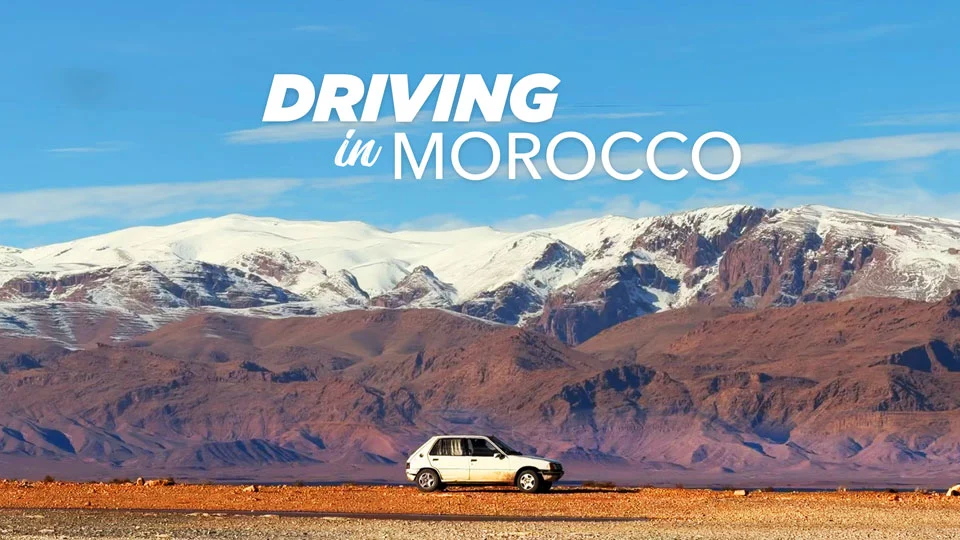
Mountain pass roads. The Tizi N'Tichka (Marrakech to Ouarzazate) and Tizi N'Test (Marrakech to Taroudant) are paved but winding, with hundreds of curves and steep drops. They're not technically dangerous, but they're tiring. Plan extra time, drive in daylight, and don't rush.
Avoid mountain pass roads after dark, in rain, or in winter snow conditions. Driving the Tizi N'Tichka at midnight in a January storm is a different experience than driving it on a sunny May morning.
Driving in Moroccan cities
Each major Moroccan city has its own driving personality. Knowing which one you're in saves you a lot of confusion.
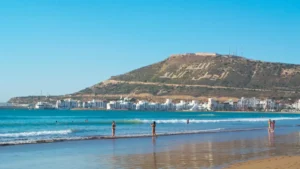
Agadir is the easiest. Rebuilt after the 1960 earthquake, it has wide boulevards, clear lane markings, organized neighborhoods, and modern traffic flow. If this is your first Moroccan city, Agadir gives you the gentlest introduction. We get more first-time Morocco drivers in Agadir than any other city, and they almost all settle in within an hour.
Marrakech is busier but still manageable outside the Medina walls. Wide boulevards in Gueliz, Hivernage, and the Palmeraie. The traffic is heavier than Agadir but follows the same rules. Inside the Medina walls, cars don't go far before the streets become foot-traffic only. Park outside one of the official lots near Bab Doukkala or Bab Robb (around 30 dirhams per day) and walk in.
Casablanca is the most intense. Heavy traffic, aggressive lane changes, and limited parking. Most tourists who fly into Casablanca pick up the car and immediately drive south or east — staying out of central Casablanca driving entirely. If you do drive in Casa, give yourself extra time and patience.
Fes and Essaouira have small, intricate medina cores where cars don't fit. Same rule as Marrakech: park outside the walls and walk in.
If you're staying in any Medina (old city), don't even attempt to drive your rental car inside the walls. Park outside, hire a porter to help with luggage if needed (20-50 dirhams), and walk in. Trying to navigate Medina alleys with a rental car is the most common stress story we hear.
Police checkpoints — what's normal
You'll encounter police checkpoints when driving outside cities. They're routine — every Moroccan driver passes through several per week. Understanding what's normal helps you stay calm.
What happens: you slow down at the checkpoint sign, the police officer either waves you through (90% of the time) or asks for documents. If asked, hand them your driving license and the rental contract. They check, often ask where you're going, and wave you on. The whole interaction takes 60-90 seconds.
Officers usually speak French as well as Arabic, and many speak basic English. "Bonjour" gets a friendly response. Stay calm, smile, answer simple questions truthfully. Most checkpoints are about general security and traffic enforcement — not about catching tourists doing anything wrong.
If an officer requests money for any reason that doesn't make sense, the answer is no. Real fines come with paperwork and receipts, never cash on the spot. We've never seen a tourist-targeted bribe attempt in our six years of business — but if it happens, politely refuse, ask for a receipt, or ask to speak to a superior officer. The situation usually resolves itself.
Always have your driving license and rental contract within easy reach (door pocket, glove box). Fumbling for documents at a checkpoint isn't dangerous, but it's slower and creates more questions.
Gas stations, tolls, and paying for things
Gas stations are abundant on motorways and major roads — Afriquia, Shell, Total, Petromin are the main brands. Diesel runs around 11.50 dirhams per liter, gasoline around 13. All stations accept cash; most accept cards. There's always an attendant who pumps the gas for you (no self-service in Morocco). A small tip (1-2 dirhams) is appreciated but not expected.
Tolls on motorways are paid at booths — cash or card both work. Have small notes ready (50 or 100 dirhams) for cash payments. The Agadir-Marrakech run costs about 80 dirhams in tolls one-way; the Casablanca-Marrakech is about 70 dirhams.
ATMs are common in cities and at major motorway rest stops, less common in small towns and rural areas. Always travel with at least 200 dirhams in cash for tolls, gas station tips, parking fees, and small road purchases.
Parking in cities is usually paid via parking attendants (gardiens) who collect 5-20 dirhams per session, or in official parking garages (10-30 dirhams per day). Both systems work fine — pay on entry or exit, keep the receipt if there is one.
Common situations and how to handle them
Stopped by police asking for documents. Hand over driving license and rental contract. Stay calm. Most interactions end in 90 seconds.
Roundabouts. Standard rules — vehicles already in the roundabout have priority. Moroccan drivers sometimes treat this loosely. Drive defensively, signal clearly, take your time entering.
Slow trucks on national roads. The N1 along the coast and the N10 to Marrakech sometimes have slow truck convoys. Pass when safe (use the dotted line sections). Don't pass on solid lines — the fines are real and Moroccan police enforce this strictly.
Honking. Moroccan drivers honk for many reasons — "I'm here," "watch out," "thanks," "hello." It's communication, rarely aggression. Don't take it personally.
Children in the road in villages. In small Berber villages, children sometimes play very close to the road. Slow down to 30 km/h or less when passing through any village, regardless of speed limit signs. Rural roads at night. Visibility drops dramatically, animals can be on the road, and breakdown assistance is harder. We strongly recommend not driving rural roads after dark unless you're already familiar with the route.
If you have a serious car problem on the road, our WhatsApp number works 24/7. We've helped customers with everything from a flat tire to getting unstuck in a sand drift on the way to Imsouane. Don't suffer in silence — message us.
What NOT to worry about
Some things foreign visitors stress about that turn out to be non-issues:
Language barriers. Road signs are in French and Arabic everywhere; English is added on main routes. Police speak French. Gas station attendants speak French. You'll be fine with basic French phrases or even English.
Carjacking, theft, or kidnapping. These are virtually unheard of in tourist Morocco. Cars are stolen sometimes (mostly in Casablanca), but tourist rental cars in Agadir, Marrakech, Essaouira, etc. are not common targets. Park sensibly, don't leave valuables visible, you're fine.
Animal hazards. Goats, donkeys, camels, dogs — yes, you'll see them near roads. They almost always stay clear of moving traffic. Slow down when passing, you're fine.
Getting lost. Google Maps works perfectly across Morocco. Cell signal covers virtually all populated areas. Download an offline map for Morocco before flying as backup, but you almost never need it.
Fuel running out. Gas stations are everywhere. The longest stretch on the Agadir-Marrakech motorway without a station is 60 km — easily covered by any rental car's tank.
The honest take
Driving in Morocco is not the white-knuckle adventure that some travel blogs make it sound. It's also not pure highway cruising. It's somewhere in between — a real country with real roads, with its own rhythm and its own quirks. Adjust to it for the first hour or two, then enjoy the freedom that having your own car gives you in Morocco.
If you're nervous, start with the Agadir region. The roads are easier, the city is cleaner, and the surrounding scenery (Taghazout, Imsouane, Paradise Valley) gives you immediate rewards for the effort. From there, you can tackle Marrakech and beyond with confidence.
If you have any specific question we didn't cover, message us on WhatsApp. We've answered every variation of "is it safe to drive in Morocco" hundreds of times — we'll happily answer yours too. The road is yours; we just hand you the keys.